A resilient travel API integration architecture is a standardized, middleware-based system that decouples customer-facing booking interfaces from third-party suppliers like Amadeus, Sabre, and direct hotel feeds. By implementing a supplier-agnostic internal abstraction layer, travel platforms eliminate system-wide outages caused by supplier schema updates, normalize fragmented payload formats, reduce API latency spikes, and protect checkout flows from third-party downtimes.
Your booking engine grinds to a halt every time a supplier updates an API endpoint without warning. Your engineering team spends sprints writing conditional patches (if supplier == 'Sabre') inside the checkout logic. Meanwhile, flight search latency spikes during peak traffic, users drop off before payment, and API overage charges from GDS providers continue to erode your margins.
This is the hidden cost of direct API coupling. In high-volume travel tech, treating GDS and hotel feeds as direct dependencies is an architectural mistake that quietly kills scaling efforts.
To stop travel API integrations from breaking during supplier schema updates, you must build a standardized internal abstraction layer between your frontend applications and third-party APIs.
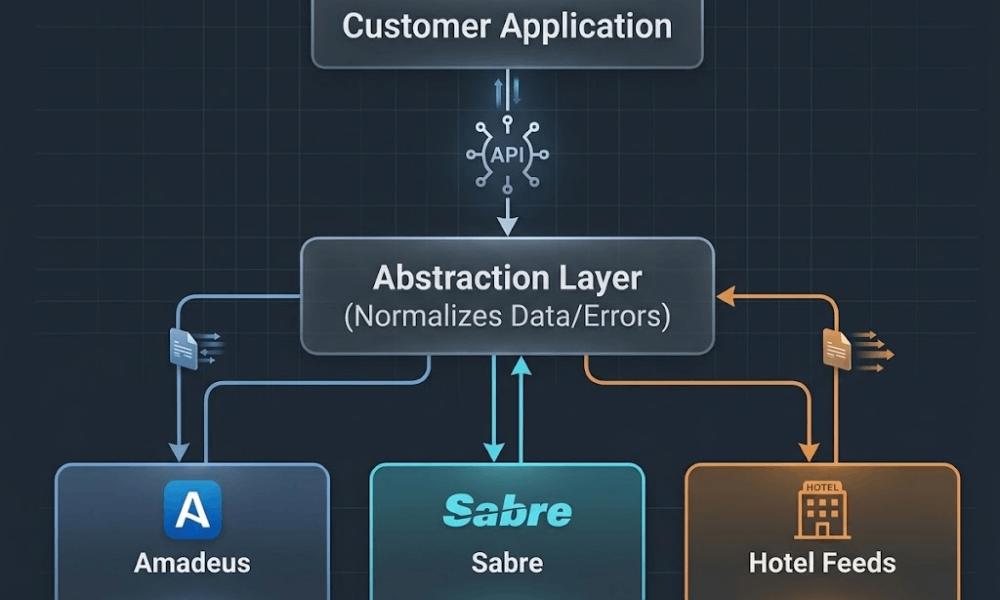
Most travel platforms in regions like the Netherlands run on an unmanaged patchwork of Amadeus REST endpoints, Sabre SOAP services, and direct hotel APIs built by different engineering teams over several years.
1. Fragmented Error Handling
Each provider uses distinct status codes, retry conditions, and session expiration limits. A 401 error in Amadeus might mean a token expiration, while in Sabre, a SOAP Fault could indicate a PNR lock issue.
2. Leaky Abstractions & Tech Debt
Conditional code living in frontend or checkout services creates tight coupling. When business rules leak into API request builders, swapping a supplier requires touching core application code.
3. Supplier Latency Spikes
Flight and hotel availability searches are notoriously slow. A single sluggish provider call during a multi-supplier search query blocks the main thread, causing cart abandonment and lower conversion rates.
Direct Coupling vs. Abstraction Layer Architecture
| Architecture Metric |
Legacy Direct Coupling |
Standardized Abstraction Layer |
| Supplier Schema Changes |
Breaks checkout flow; requires emergency hotfixes |
Isolated inside supplier adapter; zero frontend impact |
| Search Response Speed |
Limited by the slowest API provider |
Asynchronous fetch with Redis caching & P99 latency protection |
| New Supplier Onboarding |
Weeks of custom engineering & core refactoring |
Days of adapter configuration using plugin architecture |
| PCI-DSS Compliance Scope |
Spread across booking and checkout services |
Isolated strictly within a dedicated payment gateway microservice |
How to Build a Supplier-Agnostic Integration Layer
A resilient travel API architecture isolates supplier logic into modular plugins that translate external data into a unified schema.
Core Implementation Principles
-
Normalize Payloads Instantly: Convert raw JSON/XML structures into standard internal data objects immediately upon receipt.
-
Standardize Token Management: Abstract session initiation, authentication token refresh cycles, and connection pooling away from the business logic layer.
-
Plugin-Based Architecture: Treat suppliers as swap-in dependencies. Changing a commercial agreement from Sabre to Amadeus should require configuration updates rather than custom code rewrites.
High-Volume Caching & Query Optimization Strategy
Searching for flights and hotels in real time for every user query is economically and technically unviable. GDS providers charge per-search transaction fees, and legacy host systems throttle un-cached traffic.
1. Two-Tier Caching Pipeline
-
L1 Cache (In-Memory/Redis): Cache high-frequency, low-variance search grids (e.g., popular flight routes or static hotel metadata) for short durations (60–180 seconds).
-
L2 Cache (Search Indexing): Store static hotel property attributes, images, and room amenities in a local search index (Elasticsearch) to eliminate external API calls for static content.
2. Asynchronous Aggregation
Execute parallel multi-supplier searches using background workers. Stream initial search results to the client UI as soon as the fastest supplier responds, rather than waiting for slow endpoints to complete.
Essential Checklist for GDS API Integrations
Every GDS or direct hotel API integration must satisfy four architectural requirements prior to production launch:
| Step |
Focus Area |
Actionable Requirement |
| 1 |
Rate Limit Boundaries |
Define hard burst limits, per-second request quotas, and fallback queues beyond headline sales specs. |
| 2 |
Error Schema Mapping |
Map all documented and undocumented HTTP/SOAP fault responses to internal system error types. |
| 3 |
Per-Endpoint Timeouts |
Set independent timeout thresholds: e.g., low timeouts for initial search queries (1,500ms), high timeouts for booking execution (8,000ms). |
| 4 |
Sandbox Certification |
Run edge-case loads and simulated partner downtime in staging before scheduling live deployment. |
Handling Real-Time Price Changes and Seat Availability
Because GDS data changes dynamically, platforms must implement short-lived inventory holds and pre-payment re-validation steps.
-
Re-Validation Step: Execute a mandatory availability check immediately prior to triggering the payment gateway. Never trust cached search prices at checkout.
-
Short-Lived Holds: Secure a temporary booking reservation lock (typically 5 to 10 minutes) while the user inputs payment credentials.
-
Idempotency Safeguards: Attach unique client-side transaction keys to every booking call to prevent double-charging or duplicate ticket issuance during network timeouts.
Standard System Topology for Travel Tech
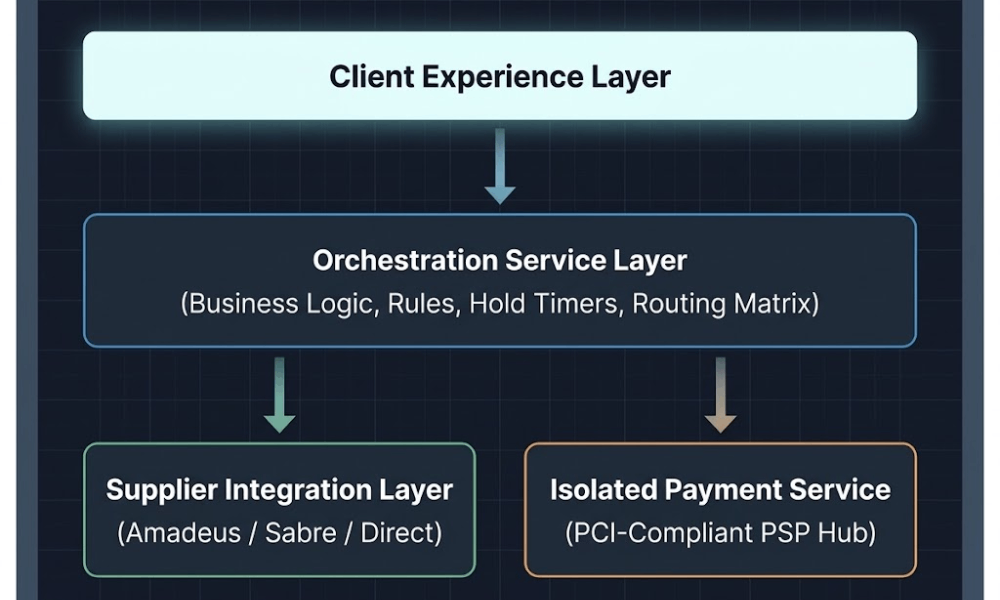
A production-grade travel platform relies on a decoupled three-tier microservice architecture. Working with dedicated travel software development company specialists ensures your system is designed for high concurrency and supplier stability from day one.
-
Supplier Integration Layer: Translates external payloads into the canonical internal schema and isolates partner outages.
-
Orchestration Service Layer: Executes domain rules, controls price hold duration timers, and evaluates routing options across providers.
-
Isolated Payment Engine: Manages payment service providers (Stripe, Adyen) independently from booking logic, keeping PCI-DSS compliance scope isolated to a single service.
Per-Supplier Observability & Target Metrics
Track real-time API performance with dedicated monitoring metrics to catch degradation before users do:
Moving from Technical Debt to an Engineering Roadmap
Most engineering leads already know where their integration layer is fragile; they just haven’t had the time or mandate to fix it properly. The gap between knowing about a problem and having a funded plan to solve it is where most travel platforms stay stuck for years.
Turning architectural improvements into business growth is where most travel platforms struggle. Beyond fixing API dependencies, read our guide on custom travel software development to learn how modernizing your tech stack directly unlocks higher booking volumes and market expansion.
If you want an outside view before committing engineering time, Bugloos offers a straightforward Code and Architecture Audit. It is a practical look at where your current integrations are costing you in reliability, developer time, or lost bookings with no sales pressure attached. Think of it as a second pair of eyes on a system you know well but rarely get the chance to step back and assess properly.
Frequently Asked Questions
What is the technical difference between Amadeus and Sabre GDS APIs?
Amadeus relies heavily on modern OpenAPI/REST architectures for its web services, whereas Sabre retains legacy SOAP-based protocols for many core PNR (Passenger Name Record) ticketing workflows. Regional inventory coverage also varies: Amadeus leads in European markets, while Sabre holds significant market share across the Americas.
How do you mitigate supplier API latency in real-time booking flows?
Implement asynchronous search requests, decouple non-critical background metadata fetch calls, use short-term Redis caching for search grids, and execute an explicit re-validation payload right before payment processing.
How should payment gateways be integrated into custom travel platforms?
Payment processing should run as a standalone service decoupled from the GDS integration. Using a tokenized payment architecture allows you to route transactions to gateways like Adyen or Stripe without triggering re-certification of the GDS booking flow or expanding your PCI compliance surface.
What does a direct hotel API integration require compared to a GDS?
Direct hotel APIs require handling raw property management system (PMS) contracts, rate parity restrictions, dynamic room mapping, dynamic cancellation windows, and overbooking prevention mechanisms without relying on GDS-level standardized record formats.