Team augmentation is a strategic IT staffing model where specialized external developers, QA engineers, or cloud architects are integrated directly into an existing in-house team on a flexible, project-by-project basis. Unlike traditional project outsourcing, augmented team members work under your direct management, adapt to your internal processes, and fill specific skill gaps without the long-term overhead and recruitment delays of permanent hiring.
For Dutch decision-makers and European tech leaders, understanding team augmentation provides a clear path toward faster product releases and optimized operational efficiency. It enables companies to respond instantly to market demands and workload surges, keeping internal teams lean while tapping into a global talent pool.
Many enterprise organizations face recurring challenges when sourcing niche technical skills or managing fluctuating project scopes. Team augmentation addresses these bottlenecks by offering an agile scaling model that aligns external expertise with internal company culture, ensuring critical software projects ship on time and within budget.
How Team Augmentation Accelerates Project Delivery and Reduces Costs
Integrating augmented team members significantly boosts software velocity by bypassing lengthy local recruitment cycles. Companies can onboard specialized senior developers in a fraction of the traditional time.
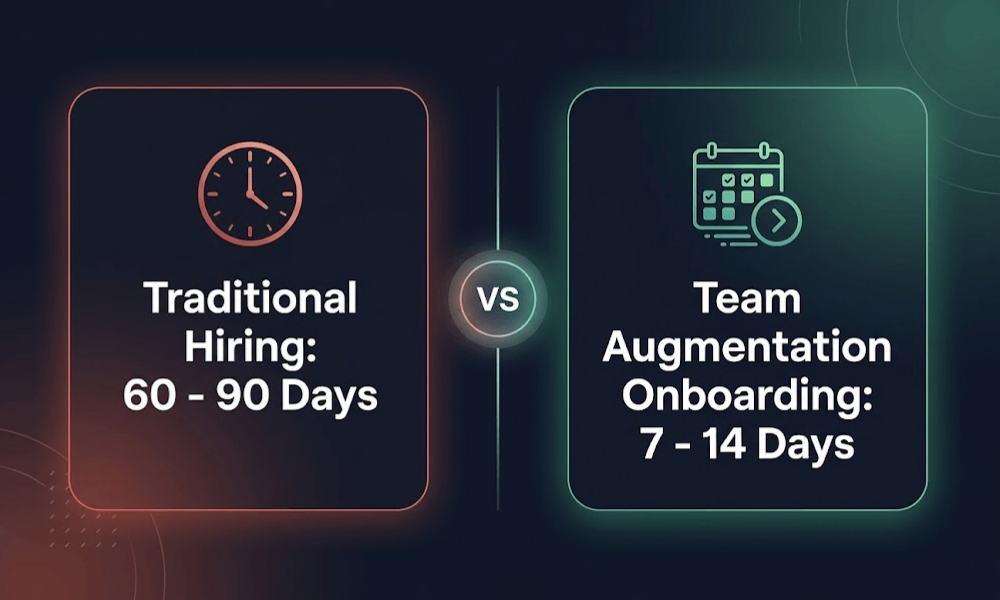
1. Faster Time-to-Market
Accessing ready-to-deploy talent reduces the ramp-up time for new features. For example, integrating an experienced cloud architect early in the cycle can shorten a complex system redesign phase by up to 20%.
2. Operational Cost Optimization
Team augmentation converts fixed employment commitments (benefits, office infrastructure, continuous training) into variable project-based expenses. This shifts your budget from long-term overhead to milestone-driven execution, controlling cost overruns and making financial planning predictable.
3. Risk Mitigation & Specialized Expertise
Access to a global talent pool allows enterprises to source experts in complex domains such as AI/ML or blockchain that may be scarce in local markets like the Netherlands. This ensures high-grade code quality, reducing expensive refactoring down the road.
What is the Meaning of Staff Augmentation?
The term staff augmentation refers to extending your core workforce with external technical talent to satisfy specific project demands or bridge temporary skill shortages. It is not about handing over an entire system to an external vendor, but about embedding individual specialists into your daily engineering workflows.
Essential Framework for Effective Implementation
To implement team augmentation effectively, engineering leaders should follow a structured four-step onboarding process:
-
1. Define Scope & Skill Requirements: Map out exact technical proficiencies, ticket responsibilities, and project milestones.
-
2. Daily Agile Integration: Include augmented engineers in daily stand-ups, sprint planning, and primary communication channels (Slack/Jira).
-
3. Establish Clear Protocols: Set up transparent reporting lines, code review rules, and escalation paths from day one.
-
4. Secure System Provisioning: Grant access to development repositories, version control (Git), and staging environments through secure IAM policies.
Team Augmentation vs. Traditional Project Outsourcing
Understanding what is meant by staff augmentation compared to traditional project outsourcing is critical for maintaining technical control and retaining core business logic:
| Dimension |
Team Augmentation |
Traditional Project Outsourcing |
| Management Control |
Direct management by your CTO, PM, or Lead Engineer |
Managed externally by the vendor’s project manager |
| Workflow Integration |
Embedded into your internal CI/CD, Slack, and Jira |
Operates in an isolated, external environment |
| Knowledge Retention |
Core insights and technical know-how stay in-house |
Externalized; higher risk of vendor lock-in |
| Flexibility |
Scale specific skill sets up or down sprint-by-sprint |
Fixed-scope deliverables with rigid change orders |
| Intellectual Property |
100% direct client ownership of all code written |
Transferred upon project completion and final payout |
Standard Architectural Topology for Enterprise Systems
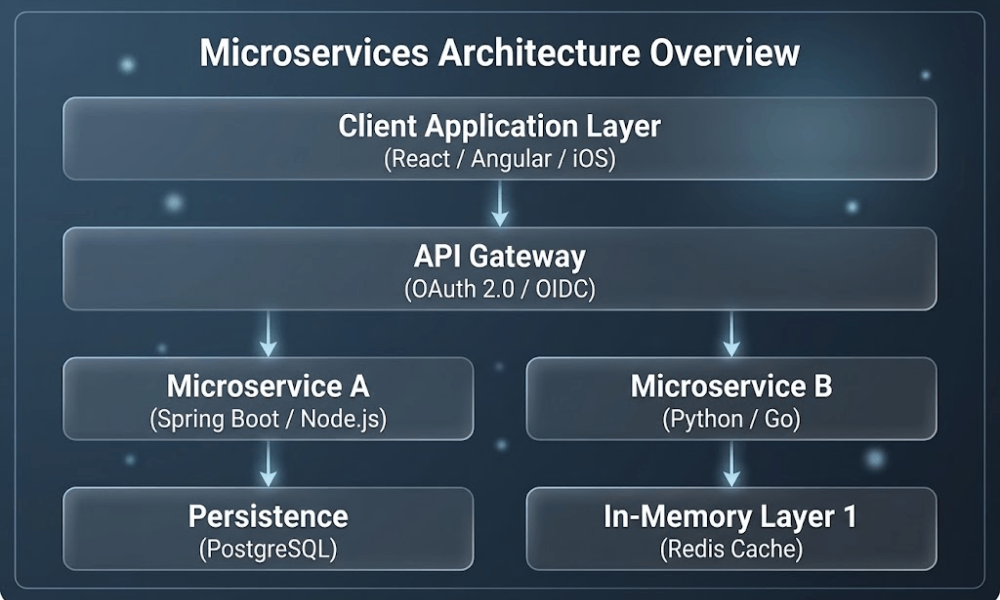
Modern enterprise software environments scaled via augmented engineering teams typically run on containerized microservices architectures designed for high availability and low latency:
-
Frontend & Gateway Layer: Modern web frameworks (React/Angular) communicating via API Gateways with OAuth 2.0 authentication.
-
Microservices Engine: Decoupled services (Node.js, Spring Boot, Go) communicating via gRPC or RESTful APIs.
-
Data & In-Memory Storage: Mixed persistence strategy utilizing relational databases (PostgreSQL) alongside distributed Redis caching to keep P99 query latency within single-digit milliseconds.
-
Cloud Orchestration: Deployed on cloud providers (AWS, Azure, GCP) using Kubernetes for automated scaling, self-healing, and continuous integration (CI/CD) pipelines.
Transitioning from Technical Debt to a Clear Engineering Roadmap
Accumulated technical debt slows feature rollouts, increases bug fix times, and consumes valuable engineering cycles. This often stems from accelerated initial development, neglected refactoring, or a lack of specialized staff to address deep architectural bottlenecks.
Understanding the current state of your codebase is the first step toward reclaiming development velocity.
Bugloos offers an objective Code & Architecture Audit designed to pinpoint integration bottlenecks, security vulnerabilities, and areas of technical debt.
(Ready to optimize your architecture? Request a comprehensive Code & Architecture Audit with our technical team.)
Frequently Asked Questions
Who benefits most from team augmentation?
Product Managers, Engineering Managers, Project Leads, and Tech Founders seeking flexible scaling models benefit most. These roles often need to rapidly adjust team size or technical capabilities without the delays and overhead of full-time local recruitment.
Is team augmentation suitable for long-term projects?
Yes. Team augmentation is highly effective for multi-year enterprise projects with evolving roadmaps. It allows companies to scale technical headcount up or down as requirements shift across different project phases.
How does team augmentation affect intellectual property (IP)?
All IP rights remain strictly with the client. Comprehensive contractual agreements established prior to onboarding specify that all code, documentation, and designs produced by augmented staff belong entirely to your company.
What are common challenges when implementing team augmentation?
Key challenges include aligning external talent with internal coding standards and establishing smooth communication. These are resolved through structured developer onboarding, daily stand-ups, and active mentoring by an internal lead engineer.