HIPAA compliant mobile app development is the process of engineering healthcare software that adheres to the HIPAA Security Rule (45 CFR Part 164) to safeguard Protected Health Information (PHI). Building a compliant mobile application for the US market requires five mandatory controls built in from sprint one: AES-256 encryption at rest, TLS 1.3 in transit, role-based access control (RBAC) with multi-factor authentication (MFA), immutable append-only audit logging retained for six years, and signed Business Associate Agreements (BAAs) with every third-party infrastructure vendor.
The financial stakes of healthcare security mistakes are severe. According to IBM, the average healthcare data breach reaches $9.77 million, making it the most expensive industry for data breaches fourteen years running. Furthermore, the US Office for Civil Rights (OCR) enforces severe penalties up to $2 million per violation category annually alongside mandatory corrective action plans.
For European and Dutch HealthTech companies expanding into the US market, GDPR and NEN 7510 compliance provide a strong foundation, but they do not automatically satisfy HIPAA. Specific differences in audit log retention, breach notification workflows, and BAA contractual mandates require dedicated engineering execution.
When planning cross-border digital health strategies, engineering teams can consult our guide on custom healthcare software development to align EU compliance with US regulatory standards.
Technical Safeguards: 45 CFR 164.312 Engineering Requirements
The HIPAA Security Rule defines technical safeguards that engineers must translate directly into application code and cloud topology.
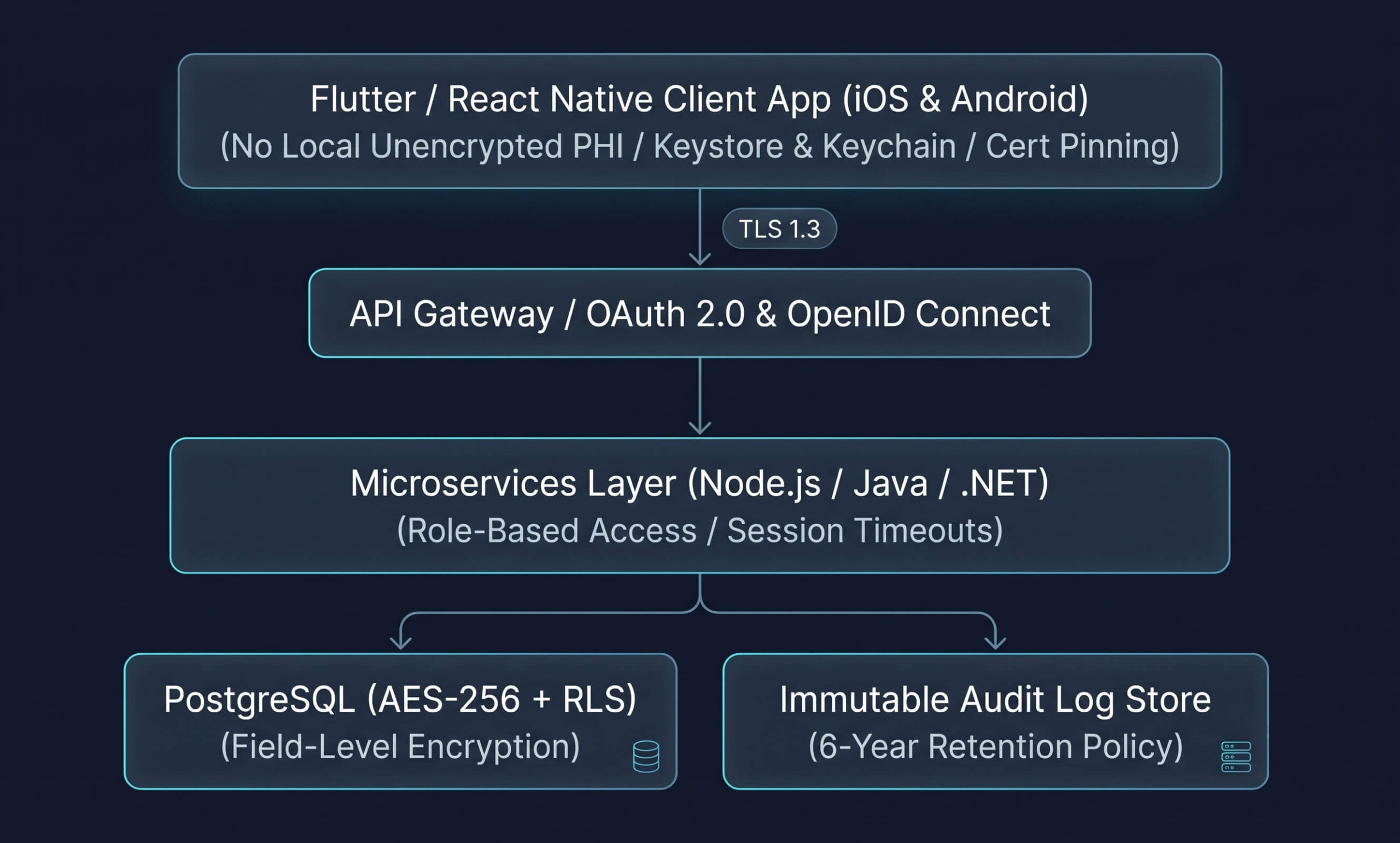
Mobile Security Checklist:
-
Zero Local Unencrypted Storage: Store sensitive tokens and keys exclusively in the iOS Keychain or Android Keystore.
-
Transmission Security: Enforce TLS 1.3 with certificate pinning on API endpoints to prevent Man-in-the-Middle (MitM) attacks.
-
Notification Payload Safety: Strip all PHI from APNs and FCM push notification payloads; deliver generic alerts that require authentication to view clinical details.
-
Immutable Audit Logging: Record every PHI access, modification, or export event into a write-once, read-many (WORM) append-only storage policy.
Embedding Compliance Into Sprint Execution
Retrofitting security controls late in development typically increases costs by 3 to 5 times due to forced rework across API contracts, logging layers, and data models. Incorporating compliance checks into your team’s Definition of Done adds only 10% to 15% to early sprint velocity while preventing launch delays.
1. PHI Data Flow Mapping & Third-Party SDK Risk Audit
2. SAST & Dependency Vulnerability Scanning in CI/CD
3. Immutable Logging & Role-Based Access Sprint Gate Review
4. BAA Verification for Production Vendor Services
Teams developing specialized patient-facing tools or clinical portals can explore our breakdown of custom mobile application development to see how secure mobile architectures integrate with cloud backends.
Overlapping HIPAA and SaMD (FDA) Requirements
If your mobile application diagnoses, treats, or informs clinical decisions, it qualifies as Software as a Medical Device (SaMD).
| Regulatory Domain |
Governing Authority |
Primary Focus |
Standard / Pathway |
| HIPAA Security Rule |
US HHS / OCR |
Patient Data Privacy & Security |
45 CFR Part 164 |
| SaMD Framework |
US FDA |
Clinical Safety & Efficacy |
IEC 62304 / ISO 13485 |
| EU Medical Device |
EU MDR |
Clinical Safety in European Union |
CE Mark (Class I-III) |
Establishing an ISO 13485 Quality Management System (QMS) alongside IEC 62304 software lifecycle controls bridges the gap between FDA premarket submissions (510(k) or De Novo) and HIPAA risk analysis requirements.
Standard Architectural Topology for Enterprise Systems
Enterprise HIPAA platforms run on microservice architectures deployed within HIPAA-eligible cloud regions (AWS or Azure) under signed Business Associate Agreements.
-
Uptime & Recovery Target: Maintain 99.9% uptime SLAs, with a Recovery Point Objective (RPO) of 15 minutes and a Recovery Time Objective (RTO) of 4 hours.
-
Key Management: Store database keys and API secrets in AWS KMS or Azure Key Vault, enforcing automated 90-day rotation schedules.
-
Penetration Testing & Audits: Run quarterly SAST/DAST pipeline scans, conduct annual third-party penetration tests, and prepare for SOC 2 Type II or HITRUST certification.

Moving from Technical Debt to a Compliant Roadmap
Most healthcare mobile platforms do not fail compliance audits due to complex cryptographic flaws; they fail on fundamental misconfigurations: PHI leaking into application logs, missing BAAs with analytics SDKs, or unencrypted local caches.
Bugloos provides an objective Code & Architecture Audit for HealthTech companies. We analyze your mobile client repositories, API contracts, cloud infrastructure, and logging pipelines against HIPAA and SaMD standards to deliver a prioritized remediation roadmap.
Frequently Asked Questions
Does a European or Dutch HealthTech company need HIPAA compliance?
Yes. HIPAA applies based on whose data you process, not where your company is registered. If your mobile application handles PHI for US patients, hospitals, or clinics, you operate as a Business Associate and must comply with the Security Rule and sign BAAs.
Is GDPR compliance sufficient to satisfy HIPAA?
No. While GDPR and HIPAA share core privacy principles, HIPAA imposes specific technical requirements, such as six-year audit log retention, signed Business Associate Agreements, and a strict 60-day breach notification rule.
Can we host HIPAA-compliant workloads on AWS or Azure?
Yes. Both AWS and Azure sign BAAs and support HIPAA workloads. However, compliance is a shared responsibility: you must limit your infrastructure to HIPAA-eligible cloud services and configure encryption, access controls, and logging correctly.
How long does HIPAA compliant mobile app development take?
A focused MVP typically takes 4 to 6 months roughly 20% to 30% longer than a standard app due to risk analyses, immutable logging, and automated security testing. If FDA SaMD clearance applies, add 6 to 12 months for regulatory processing.