Your backlog looks like a medical chart for a patient who ignored symptoms for years. Deadlines slip, EHR integrations fail silently, clinicians complain about latency, and vendor invoices keep arriving. This is the structural tech debt of mobile development in healthcare and as a CTO, you are the one responsible for re-architecting the roadmap.
Off-the-shelf healthcare software offers a short-term velocity illusion that quickly dissolves into an endless loop of custom patches. While it saves initial sprint cycles, you pay for it later with rigid clinical workflows, data pipeline vulnerabilities, and compounding maintenance costs.
This playbook skips marketing rhetoric and addresses the architectural, operational, and compliance strategy required to build scalable, high-performant healthcare mobile software.
1. Security & Compliance: Shift Left to Threat Modeling
Security in healthcare cannot be a QA checklist item executed right before release. Attempting to retroactively wrap HIPAA, GDPR, or SOC2 compliance around a finished architecture introduces massive refactoring overhead and structural vulnerabilities.
Architectural Imperatives:
- Zero-Trust API Architecture: Enforce strict RBAC (Role-Based Access Control) and ABAC (Attribute-Based Access Control) at the gateway level. Token validation, key rotation, and session management must happen before requests reach your microservices.
- Storage Encryption & Key Management: Secure data at rest using AES-256 with hardware-backed key storage (iOS Keychain / Android Keystore). Never persist raw Protected Health Information (PHI) in unencrypted local SQLite databases.
- Auditable Log Streams: Implement native, tamper-evident audit logging for every PHI read, write, and export operation. Audit trails should stream asynchronously to a secure SIEM without blocking the primary application thread.
- Execution Strategy: Define security control points in the system architecture document before sprint zero. Ensure your delivery partner delivers validated, end-to-end audit traces alongside functional feature slices in every sprint demo.
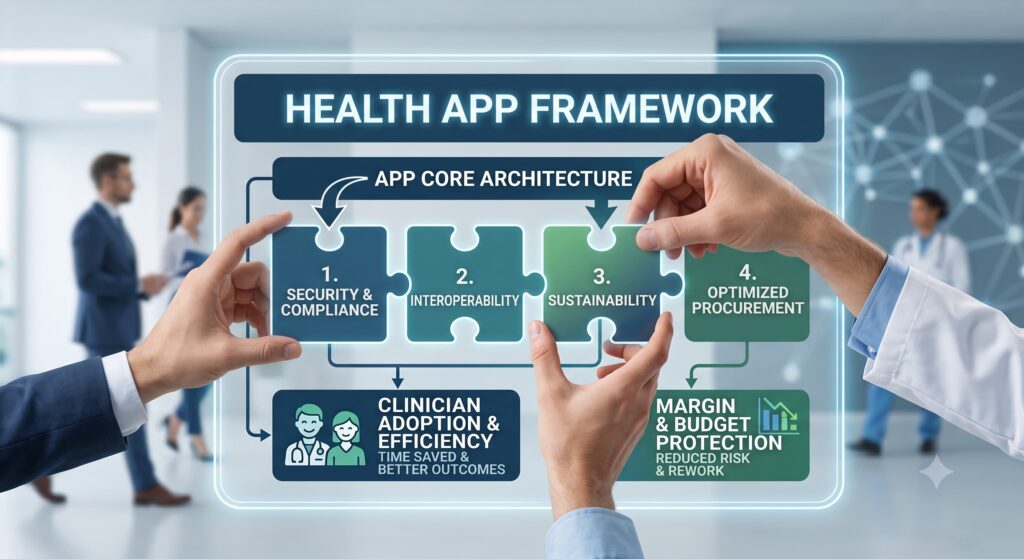
2. Interoperability: Architectural Patterns over Custom Adapters
- Poor integration strategy is the single biggest driver of long-term healthcare tech debt. If your application layer is tightly coupled to a specific EHR provider, every API schema change will trigger cascading codebase refactors.
+-----------------------------------------------------------+
|                   Mobile Client (UI)                      |
+-----------------------------------------------------------+
                              |
                     [REST / GraphQL]
                              v
+-----------------------------------------------------------+
|              Integration & Abstraction Layer              |
|   (SMART on FHIR / OAuth2 / OAuth Scopes / Data Mapping)   |
+-----------------------------------------------------------+
           |                  |                   |
    [FHIR / REST]       [HL7 v2 / MLLP]      [REST / gRPC]
           v                  v                   v
+------------------+  +------------------+  +---------------+
| Modern EHR Systems|  |  Legacy EHR Systems|  | Medical Devices|
| (Epic, Cerner)   |  |  (Engine / Mirth)|  | (IoMT / Edge) |
+------------------+  +------------------+  +---------------+
-
Decouple with an Abstraction Layer: Never connect the mobile client directly to proprietary EHR APIs. Place an integration layer/gateway in between to translate internal domain models to standard protocols (FHIR R4 / HL7).
-
Standardize Authentication: Utilize SMART on FHIR standards and OpenID Connect for unified single sign-on (SSO) across enterprise hospital identity providers.
-
Contract-First API Design: Establish strict OpenAPI/Swagger specifications and FHIR resource mappings early. Use mock servers and staging EHR environments to validate payload schemas during localized dev sprints.
3. Delivery & SLA Strategy: Managing the Lifecycle Cost
Engineering a clinical-grade application requires an operational model built for high availability and low mean time to recovery (MTTR). Vendors that act as simple feature factories leave you with unmaintainable codebases once the initial contract terminates.
Core Metrics for Technical Partners:
- Crash-Free Session Rate: Maintain a >99.9% target for clinical-facing builds.
- API Latency & MTTR: Enforce explicit SLAs for endpoint response times (p95 < 200ms) and critical bug fixes (< 4 hours for P1 issues).
- Automated Test Coverage: Mandate unit, integration, and UI automation coverage thresholds (>80%) within the CI/CD pipeline to prevent regression in core workflows.
Refactoring tech debt shouldn’t be an afterthought it must be budgeted as a continuous 15-20% allocation in every sprint backlog.

Case Study: High-Throughput Data & Offline Sync in the Operating Room
The Technical Challenge
A leading European Cancer Institute required a digital platform for Electrochemotherapy (ECT) procedures. Surgeons needed to capture high-resolution imagery, process AI-assisted clinical telemetry, and log precise surgical parameters in real time within the Operating Room (OR).
Key constraints included zero latency during active procedures, strict network isolation inside OR environments (frequent internet loss), and absolute data consistency.
The Engineering Solution (Engineered by Bugloos)
Offline-First Engine: Built a local-first persistent data layer using optimized SQLite/Realm instances. Surgical data writes occur locally with zero network reliance, guaranteeing sub-millisecond UI responsiveness.
Delta Sync & Conflict Resolution: Implemented a custom synchronization pipeline that queues operations locally, compresses high-resolution surgical imagery on edge, and executes transactional delta-syncs with the central database upon network restoration.
Edge-AI Inference: Embedded localized machine learning models directly on-device to automate data entry and image processing, eliminating latency and avoiding cloud payload roundtrips during critical surgical steps.
Technical Outcomes
0% Data Loss: Achieved fault-tolerant operation across disconnected OR environments.
Workframe Efficiency: Reduced clinical data entry overhead by over 40%, eliminating procedural delays.
Scalable Architecture: Seamlessly connected edge data processing back to enterprise clinical databases without performance degradation.
Technical Strategy Roadmap: The 90-Day Plan
If your current architecture is draining engineering bandwidth, execute a targeted 90-day stabilization plan:
-
Days 1–30 (Audit & Isolate): Run an architectural and compliance audit. Identify core bottlenecks in your EHR integration layer, audit security boundary gaps, and map technical debt hot spots.
-
Days 31–60 (Decouple & Automate): Introduce an API gateway to abstract legacy dependencies. Automate end-to-end security scanning and FHIR schema validation in your CI/CD pipeline.
-
Days 61–90 (Refactor & Scale): Address high-priority MTTR bottlenecks, optimize local persistence layers for offline resilience, and re-align team capacity around long-term SLAs.
Frequently Asked Questions (Technical & Operational)
How do you handle HL7 v2 to FHIR migration for legacy hospital integrations?
We build an intermediate adapter layer (often leveraging middleware like Mirth Connect or custom engine services) that maps incoming HL7 v2 messages (e.g., ADT, ORU) into standardized FHIR R4 JSON payloads. This abstracts legacy messaging formats away from the mobile client’s modern API layer.
What is the recommended strategy for offline-first data sync in HIPAA-compliant apps?
All local data must be stored in encrypted databases (e.g., SQLCipher) using keys managed by the OS hardware security module. The sync architecture should utilize queue-based event sourcing with deterministic conflict resolution (e.g., vector clocks or field-level CRDTs) to reconcile offline changes with the server upon reconnection.
How do you maintain CI/CD pipelines when dealing with strict healthcare regulations?
We embed compliance checks directly into the continuous integration pipeline. This includes automated static application security testing (SAST), dynamic dependency vulnerability scanning, automated UI regression testing for critical clinical flows, and automated generation of audit-ready release documentation for every build.
Moving from Tech Debt to a Scalable Architecture
Remediating healthcare tech debt requires an objective analysis of your current stack, integration models, and security posture.
Bugloos provides an in-depth Code & Architecture Audit designed for technical leaders. We evaluate your mobile stack, audit FHIR/EHR interface layers, analyze local storage security, and deliver a detailed engineering roadmap focused on stabilizing performance and scaling velocity. Schedule a Technical Architecture Audit with Bugloos