Custom travel portal development services involve engineering bespoke B2B and B2C booking platforms, Global Distribution System (GDS) API integrations, and inventory management engines tailored to the specific operational workflows of Online Travel Agencies (OTAs), Tour Operators, and Travel Management Companies (TMCs). Unlike off-the-shelf SaaS software, custom travel software development delivers complete data ownership, eliminates per-booking vendor fees, and delivers the architectural scalability needed to handle dynamic pricing and multi-supplier inventory aggregation.
For decision-makers across Europe, investing in a purpose-built booking portal means moving beyond generic interfaces to own a proprietary digital asset. Off-the-shelf travel portals introduce rigid operational ceilings, impose high transaction fees, and restrict your ability to build custom agent commission structures or unique packaging rules. To see how modernizing your booking engine impacts business growth at scale, read our ultimate guide to scaling your business with travel agency software.
Partnering with a specialized travel portal development company allows enterprise travel providers to automate complex booking flows, streamline multi-currency settlements, and maintain full compliance with European data security standards like GDPR and PCI DSS.
B2B Travel Portal Development vs. B2C Booking Platforms
Understanding the functional differences between B2B and B2C travel portals is essential when defining your software architecture:
| Platform Feature |
B2B Travel Portal Development |
B2C Booking Portal |
| Primary Audience |
Travel agents, sub-brokers, corporate TMC clients |
Individual retail travelers and consumers |
| Pricing & Margins |
Dynamic agent markups, tiered commission rules, credit line management |
Net rates, promo codes, direct payment gateway checkout |
| Inventory Aggregation |
Multi-GDS feeds (Amadeus, Sabre), wholesaler APIs, direct contracts |
Curated search results optimized for fast conversion and low latency |
| User Authentication |
Corporate SSO, role-based access control (RBAC), agent portals |
Social logins, guest checkout, loyalty program integration |
How Custom Solutions Eliminate Core Operational Inefficiencies
Legacy platforms create operational bottlenecks that force travel companies into manual workarounds and data reconciliation errors. Custom engineering solves these points directly:
-
Automated Multi-Supplier Inventory Aggregation: Merges disparate flight, hotel, and car rental API feeds into a single normalized search grid in real time.
-
Complex Business Logic Encoding: Custom-builds rules for dynamic package bundling, corporate policy validation, and automated deposit tracking without manual intervention.
-
Multi-Currency European Payment Gateways: Integrates localized payment gateways (Adyen, Stripe, SEPA) to handle multi-currency settlements and automated reconciliation.
As a specialized travel software development partner, Bugloos engineers booking platforms that eliminate repetitive manual tasks, allowing core teams to focus on revenue-generating activities.
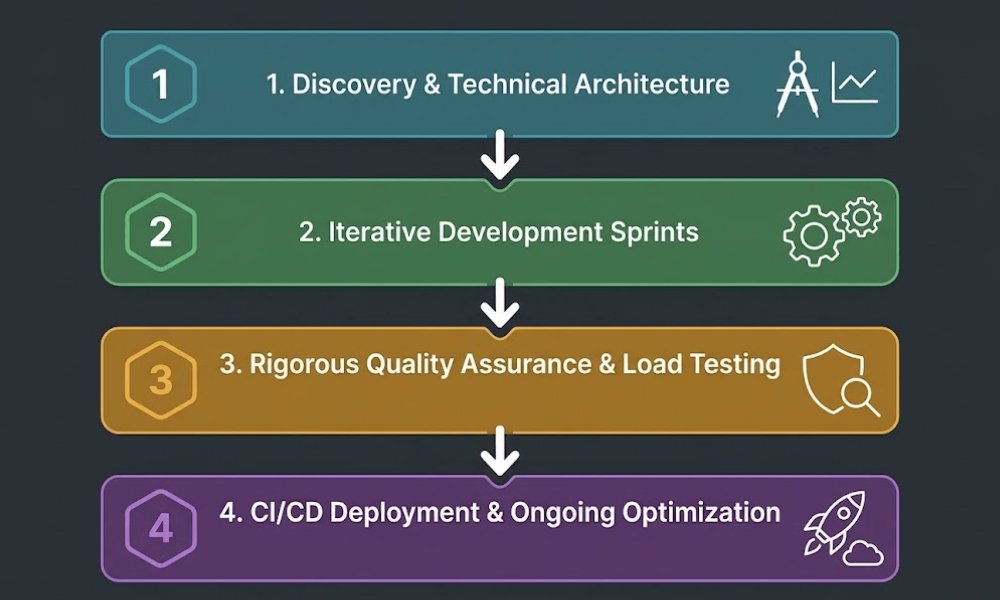
The Technical Roadmap for Custom Travel Portal Development
Building a high-volume booking engine requires a disciplined, structured engineering methodology. When developing travel software for enterprise platforms, following a clear roadmap prevents scope creep and ensures long-term stability:
Strategic Implementation Steps:
-
Discovery & Requirements Analysis: Define user stories, map GDS endpoint specs, and establish clear technical scope parameters.
-
Architectural Design: Structure microservices boundaries, database schemas, and API gateway rate-limiting rules.
-
Agile Sprints & Continuous Testing: Build core booking engines iteratively with automated unit testing and contract testing for supplier APIs.
-
Deployment & Cloud Infrastructure: Launch via automated CI/CD pipelines on cloud infrastructure engineered for 99.99% uptime.
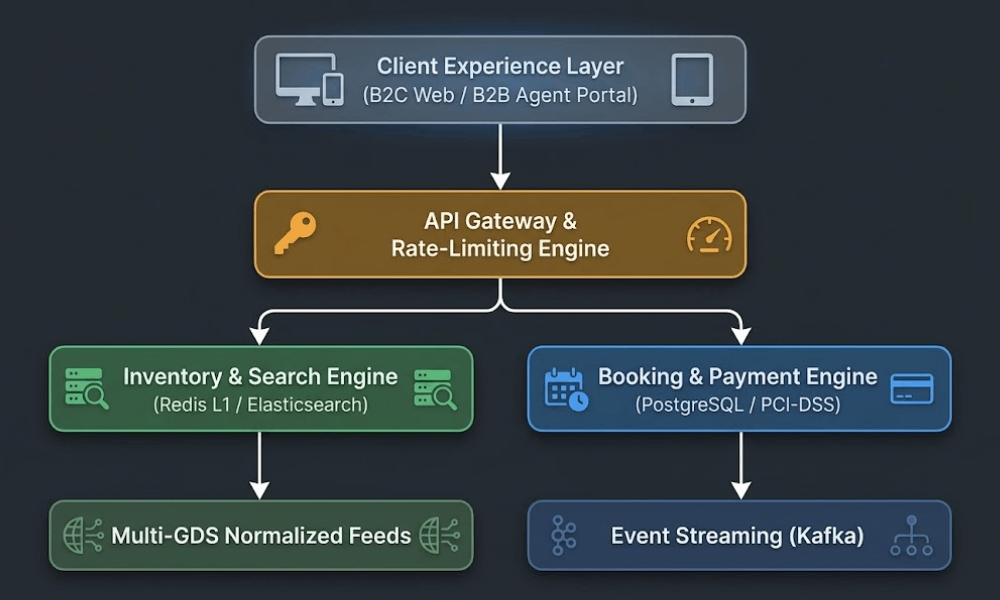
Standard Architectural Topology for Enterprise Systems
Enterprise travel platforms utilize a layered, microservices-based topology deployed on cloud infrastructure (AWS, GCP, Azure) to maintain performance during peak traffic surges:
Key Technical Stack Components:
-
Decoupled Backend Microservices: Built with high-performance frameworks (Node.js, Go, Python) communicating via RESTful or gRPC APIs.
-
Hybrid Database Persistence: Relational databases (PostgreSQL) for transactional booking data combined with NoSQL (Elasticsearch, Redis) for sub-second search indexing.
-
Cloud Orchestration & Message Queuing: Kubernetes-managed containers running Apache Kafka for real-time price hold events and inventory sync.
-
Security-By-Design: PCI DSS compliance for tokenized payments, GDPR-compliant data anonymization, and Role-Based Access Control (RBAC).
Transitioning from Technical Debt to a Scalable Engineering Roadmap
Unaddressed technical debt in outdated booking systems drains engineering budgets, increases maintenance overhead, and creates severe downtime risks during high-traffic sales periods.
Understanding where technical debt resides within your codebase is the critical first step toward rebuilding development velocity.
Bugloos provides a comprehensive Code & Architecture Audit to evaluate your existing booking pipelines, identify supplier integration bottlenecks, and deliver an actionable modernization roadmap.
(Ready to eliminate technical debt in your booking portal? Request an Architecture & Code Audit with our technical team today.)
Frequently Asked Questions
What are the main benefits of custom travel portal development services?
Custom travel portal development services deliver full ownership over your proprietary software, eliminate per-booking SaaS fees, allow custom supplier integrations, and scale seamlessly without performance bottlenecks during peak booking surges.
What core technologies are used by a modern travel portal development company?
Enterprise travel portals rely on cloud-native microservices, Docker/Kubernetes containerization, PostgreSQL for transactional data, Redis/Elasticsearch for fast search grids, and OAuth 2.0 API Gateways for secure multi-GDS connections.
How long does it take to develop an enterprise B2B travel portal?
Developing an enterprise-grade B2B travel portal typically takes between 6 to 12 months, depending on the number of GDS supplier APIs, custom commission rules, and third-party payment gateway integrations required.
How do custom travel portals ensure GDPR and PCI DSS compliance?
Custom platforms isolate payment flows into dedicated tokenized environments to meet PCI DSS requirements. GDPR compliance is enforced through end-to-end encryption (TLS 1.3/AES-256), automated data retention rules, and strict Role-Based Access Control (RBAC).