Choosing between a custom or white label flight booking engine comes down to speed versus commercial control. A white label solution gets a travel business to market in 8 to 12 weeks for €20,000–€60,000 upfront but charges per-booking fees and limits custom agency workflows. A custom B2B engine requires 6 to 12 months and €150,000+ upfront but delivers full ownership of margins, supplier contracts, markup rules, and sub-agent hierarchies.
For B2B travel resellers, consolidators, and Travel Management Companies (TMCs) operating on tight margins (2% to 8% per ticket), your software architecture directly dictates profitability.
A generic platform that cannot model your complex commission tiers, sub-agent credit limits, or net fare deals will leak margin on every transaction. If your booking flow is standard, rent a platform; if your custom pricing logic and agency hierarchy are how you win business, build it.
What Does a B2B Flight Booking Engine Actually Need to Do?
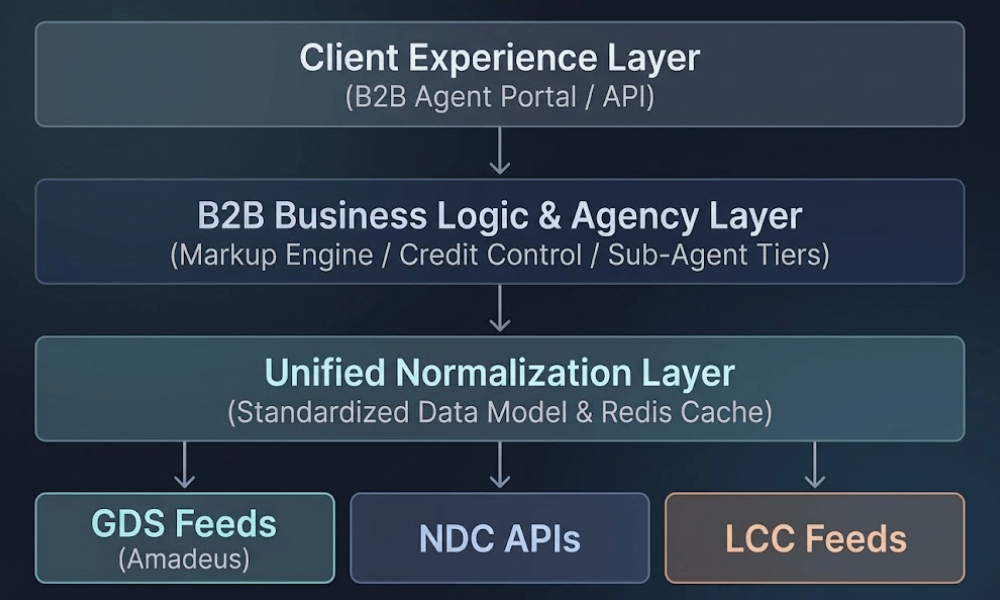
A B2B flight booking engine is a distribution and agency management platform, not just a consumer search box. Its primary job is to aggregate content from GDS channels (Amadeus, Sabre, Travelport), NDC APIs, and LCC aggregators, then resell it through your agent network under your commercial rules.
Core Requirements:
-
Sub-3-Second Search Latency: Aggregating 3 to 6 sources in under 3 seconds to prevent agent abandonment.
-
Aggressive Search Caching: Managing look-to-book ratios (often exceeding 500:1) using Redis to control GDS search fees.
-
Agency Management Layer: Supporting multi-level sub-agent hierarchies, customized deposit lines, role-based access control, and automated accounting settlements.
Building these complex multi-GDS and agency pipelines requires specialized expertise in developing travel software to ensure core checkout flows remain stable under load.
How Do You Decide Between Custom and White Label?
The honest answer is that most companies should not decide on gut feeling. Run a short structured assessment before signing anything. The four checks below separate businesses that can rent a platform from businesses that need to own one.
- Map your pricing rules: if you have more than 10 distinct markup or commission scenarios, most white label tools cannot model them.
- Count your integrations: CRM, accounting, mid-office, and payment systems each add cost and risk on a closed platform.
- Check your volume: above roughly 1,000 bookings per month, per-booking fees often exceed custom hosting costs.
- Test your exit: ask the vendor for a written data export and migration policy before you sign.
Score yourself honestly on these four points. If you fail two or more, a white label flight booking engine will work for the first year and hurt you in year three. If you pass all four, renting is the rational move, and you should spend your capital on sales and supplier deals instead of code.
What Do the Costs Really Look Like Over Five Years?
White label pricing looks cheap upfront and gets expensive with success. A typical deal includes a €10,000 to €40,000 setup fee, €1,000 to €4,000 in monthly licensing, and a per-booking fee of €0.50 to €2.00. At 2,000 bookings per month, the per-booking fees alone can reach €48,000 per year. Over five years, a successful reseller often pays €250,000 or more for a platform they will never own.
Custom development inverts that curve. Expect €150,000 to €400,000 for a solid first version, built over 6 to 12 months, plus 15 to 20 percent of the build cost per year in maintenance. The break-even point against white label fees usually lands between year two and year three at moderate volume. After that point, every booking runs on infrastructure you own, at hosting costs of €500 to €2,000 per month.
The hidden factor is optionality. A custom platform lets you add hotel content, launch a b2c flight booking engine on the same backend, or white-label your own product to smaller agencies. Each of those moves creates new revenue on a codebase you already paid for. A rented platform gives you none of that upside, because the vendor owns the roadmap.

Standard Architectural Topology for Enterprise Systems
A modern b2b flight booking engine follows a layered architecture. The supply layer connects to GDS APIs from Amadeus, Sabre, or Travelport, to NDC endpoints from carriers like Lufthansa Group and Air France-KLM, and to low-cost carrier aggregators. The aggregation layer normalizes all fares into one internal format, deduplicates itineraries, and applies Redis caching to keep search fast and GDS fees low.
Above supply sits the business logic layer, and this is where B2B complexity lives. Markup engines, commission calculators, credit control, and booking workflows run best as separate services connected through REST APIs and a message queue such as RabbitMQ. This separation matters in practice: a change to a pricing rule should never require redeploying the search service. Data lives in PostgreSQL for transactional records and in a fare cache built on Elasticsearch.
Operational numbers define whether the architecture works. Search responses should stay under 3 seconds at the 95th percentile, and booking confirmation under 10 seconds including GDS PNR creation. Uptime of 99.9 percent is the industry floor, since one hour of downtime during peak windows can cost a mid-size consolidator €5,000 to €20,000 in lost bookings. Autoscaling on AWS or Azure handles seasonal peaks like the January booking surge.
Security and compliance are not optional in flight distribution. PCI DSS applies when the platform touches card data, and GDPR covers every passenger record stored on European infrastructure. Practical best practices include tokenized payments through providers like Adyen or Mollie, full audit logs on every fare change, and automated alerting when error rates pass 1 percent. These controls protect both your IATA accreditation and your client relationships.
Final Thoughts
The core problem is straightforward. Travel resellers need booking technology that matches their commercial model, and generic platforms rarely do. A white label flight booking engine buys speed and low upfront cost. A custom b2b flight booking engine buys control, margin protection, and a platform that grows with your supplier deals instead of blocking them.
The decision comes down to volume and complexity. Below 1,000 bookings per month with simple pricing, rent. Above that, or with layered agency structures and multiple integrations, the five-year math favors building. Companies that act on this analysis stop paying per-booking fees to a vendor and start compounding value in an asset they own.
Moving from Tech Debt to a Roadmap
Many travel companies are stuck in the middle: a white label platform patched with manual workarounds, spreadsheets for commission settlement, and a vendor roadmap that never matches their needs. That situation is technical debt, even if you never wrote the code. The way out is not a dramatic rebuild but a staged migration plan that keeps bookings flowing while ownership shifts to you.
If you want a factual starting point, Bugloos offers an objective code-and-architecture audit for travel platforms. We map where your margin is actually leaking, whether that is GDS fees, per-booking charges, or manual processes, and deliver a written report you can act on with or without us. It is a low-pressure way to replace assumptions with numbers before you commit budget.
Frequently Asked Questions
How long does it take to build a custom B2B flight booking engine?
A production-ready custom b2b flight booking engine typically takes 6 to 12 months with a focused team of 4 to 6 engineers. A first working version with one GDS connection and core agency management can launch in about 4 to 5 months. Timelines extend when NDC integrations, multi-currency settlement, or mid-office connections are added.
Can we start with a white label solution and move to custom later?
Yes, and this is a common path: use a white label flight booking engine to validate demand, then build custom once volume justifies it. Plan the migration early by securing data export rights in your vendor contract. Companies that skip this step often lose booking history and agency data during the switch.
What is the difference between a B2B and a B2C flight booking engine?
A b2c flight booking engine sells single tickets directly to consumers with card payment at checkout. A B2B engine serves agency networks and adds markup rules, commission tiers, credit limits, and sub-agent hierarchies. The B2B version is commercially more complex, even when the flight search technology underneath is identical.
Which suppliers should a booking engine connect to first?
Start with one GDS, usually Amadeus or Travelport in the European market, since a single GDS covers most full-service carrier content. Add low-cost carrier coverage next, either through direct APIs or an aggregator. NDC connections to key carriers like Lufthansa Group come third, driven by fare advantages of 5 to 15 percent on specific routes.