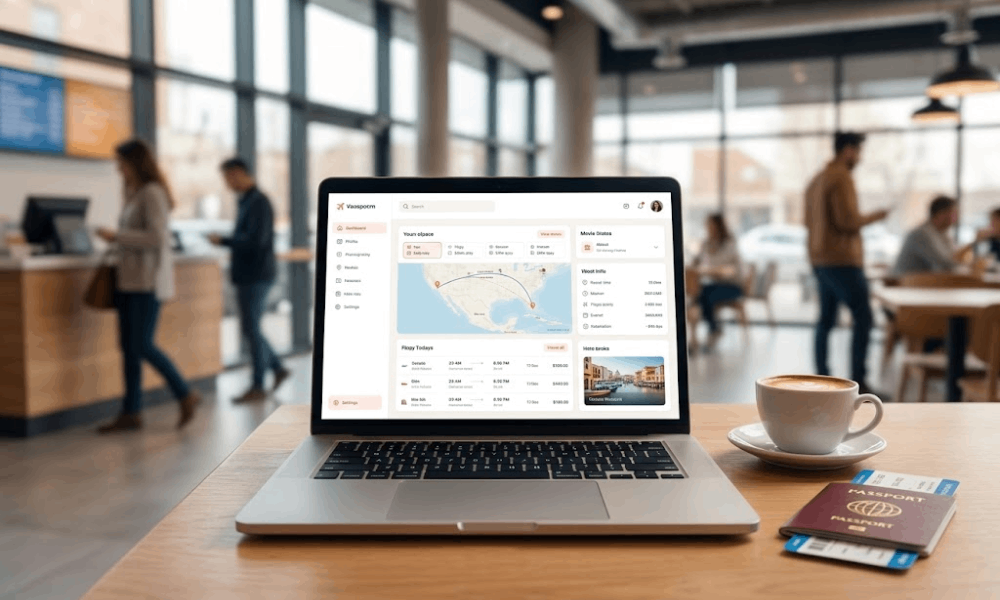
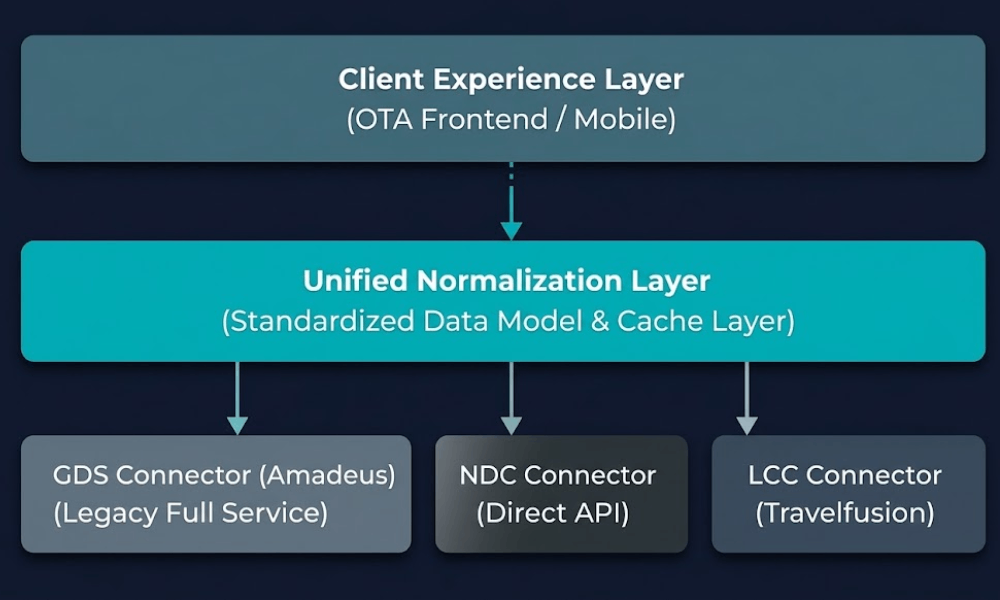
Flight Booking Engine API Integration connects an Online Travel Agency (OTA) or travel platform to multiple airline content sources including Global Distribution Systems (GDS like Amadeus and Sabre), IATA NDC feeds, and Low-Cost Carrier (LCC) aggregators through a single, normalized middleware layer. This architecture isolates supplier-specific quirks, maintains sub-second search latency, minimizes look-to-book penalties, and enforces strict European regulatory compliance (GDPR, PCI DSS, and PSD2).
The fastest way to de-risk flight booking engine integration in Europe is to build one unified normalization layer between your front end and external content suppliers.
Without this abstraction layer, supplier-specific quirks pollute your codebase. Every new supplier addition becomes a high-risk, expensive refactoring project instead of a simple 6-week connector launch.
Commercial stakes in flight search are brutal: a single-second delay in returning search results can cut conversion rates by 5 to 10 percent. Users routinely abandon searches that exceed 5 seconds. For an OTA executing 10,000 daily searches, even a 2% booking failure rate results in massive, direct revenue loss.
Which Flight Content Sources Should You Connect To?
Relying on a single content provider is no longer commercially viable in the European market. A resilient flight platform aggregates three distinct supplier models:
-
Global Distribution Systems (GDS): Platforms like Amadeus, Sabre, and Travelport give instant access to ~400 airlines under one contract. However, GDS channels often lack the lowest fares due to airline distribution surcharges.
-
IATA NDC Channels: Airlines like Lufthansa Group and Air France-KLM push their best fares and rich ancillaries through NDC APIs, bypassing traditional GDS surcharges (€10–€20 per ticket).
-
Low-Cost Carrier (LCC) Aggregators: Ryanair, Wizz Air, and easyJet carry a massive share of intra-European traffic, but their inventory rarely sits in a GDS. Connecting via aggregators like Travelfusion or direct APIs is mandatory for full market coverage.
The Realistic Integration Timeline (Without Overruns)
Most flight API projects overrun because engineering teams underestimate GDS certification queues and testing protocols not the actual coding. A realistic timeline for a first GDS integration runs 4 to 6 months.
-
Secure Contracts & Sandbox Access First: GDS certification queues alone take 4 to 8 weeks.
-
Define Your Internal Data Model: Establish your internal schema before writing any supplier code so every source translates into the same structure.
-
Plan Caching Early: GDS contracts penalize “look-to-book” ratios exceeding roughly 500 searches per booking.
-
Scope Compliance on Day One: Deciding late whether you store card data forces a complete payment-flow rewrite.
Treat these steps as strict sequential gates. Skipping data modeling to save two weeks always returns as two months of technical debt when the second supplier arrives.
To explore tailored portal architecture strategies, see our guide on custom travel portal development services.
High-Performance API Architecture for Flight Search
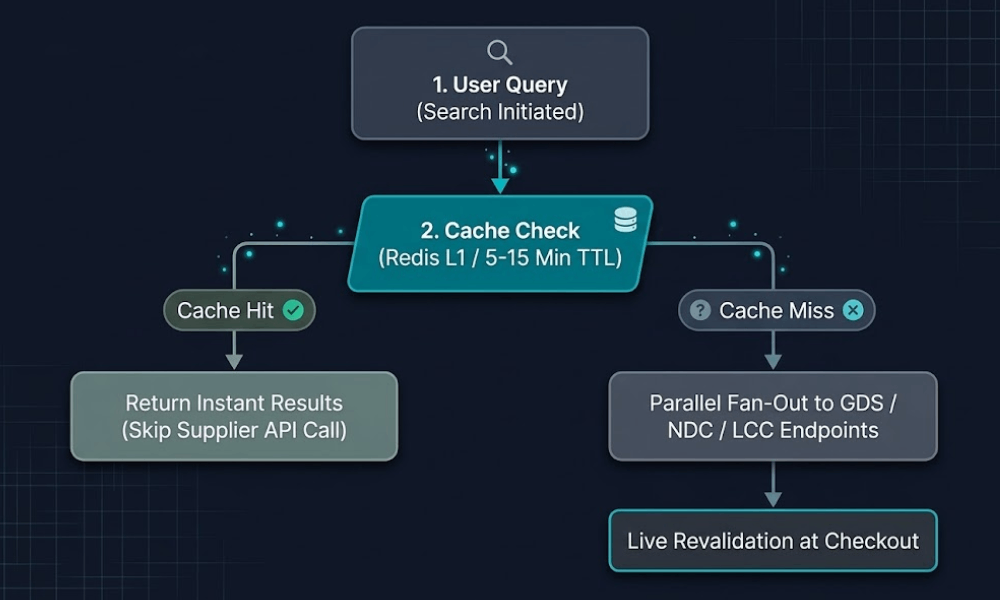
Flight search is a parallel fan-out problem. A single user query triggers concurrent requests to every connected supplier. Your orchestration layer must merge, deduplicate, and rank results within a strict latency budget: first meaningful result in < 3 seconds, complete set in < 8 seconds.
Key Engineering Patterns:
-
Redis Caching: Caching search responses for 5 to 15 minutes cuts supplier API calls by 40% to 70%, protecting look-to-book ratios.
-
Live Price Revalidation: Execute a live revalidation call at the exact moment of booking selection so users never experience stale fare drop-offs.
-
Resilience Protocols: Implement circuit breakers (e.g., Resilience4j) to isolate failing supplier APIs, exponential backoff retries for transient network drops, and idempotency keys to prevent double-ticketing.
When building complex multi-GDS engines, leveraging specialized travel software development ensures core checkout pipelines stay resilient under heavy traffic.
Standard Architectural Topology for European Platforms
Enterprise flight platforms decouple monolithic systems into specialized, independently deployable microservices:
| Service Boundary |
Technical Responsibility |
Primary Tech Stack |
| Search Orchestration |
Fan-out queries, deduplication, cache reads, hard timeouts |
Go / Node.js |
| Supplier Connectors |
Payload transformation, raw GDS/NDC protocol translation |
Isolated Docker / K8s Microservices |
| Booking & Order Engine |
Order state machine, PNR creation, ticketing queues |
Java / PostgreSQL (ACID) |
| Payment Service |
PCI DSS scope isolation, PSD2 SCA enforcement |
Adyen / Stripe SDKs |
Peak search traffic in European travel spikes 3x to 5x above baseline during January booking surges and summer sales. Kubernetes with horizontal pod autoscaling is the standard runtime, sized for spikes rather than averages.
Moving from Technical Debt to a Roadmap
Most travel platforms do not need a complete rewrite; they need an honest map of where the current integration leaks money. Common leaks include look-to-book penalties from missing caches, supplier logic tangled into the booking flow, and manual ticketing fallbacks.
If you are looking to audit your current architecture, read our full technical breakdown on developing travel software.
Bugloos offers an objective Code & Architecture Audit for travel platforms. We review your supplier connectors, caching strategy, latency budgets, and compliance scope, then show where margin is actually leaking and in what order to fix it.
(Ready to eliminate technical debt in your booking portal? Request an Architecture & Code Audit with our technical team today.)
Frequently Asked Questions
How long does a flight booking engine integration take in Europe?
A first GDS integration typically takes 4 to 6 months from contract signing to production. Subsequent suppliers (NDC APIs or LCC aggregators) take roughly 6 to 10 weeks if a normalization layer already exists.
Should an OTA start with a GDS or NDC APIs?
Start with a GDS (like Amadeus or Travelport) to gain immediate access to ~400 airlines under one contract. Add NDC connections next for carriers like Lufthansa Group or Air France-KLM to unlock exclusive fares.
What does a B2B flight booking engine cost to operate?
For a mid-sized European OTA, ongoing infrastructure, GDS fees, and maintenance cost between €15,000 and €50,000 per month. Caching is the biggest cost lever, reducing supplier calls by 40% to 70%.
How do travel platforms maintain GDPR and PCI DSS compliance?
Isolate payment handling within a PCI-compliant provider (like Adyen or Stripe) to shrink audit scope. Store Passenger Name Records (PNR) under strict GDPR retention rules and embed PSD2 Strong Customer Authentication (SCA) directly into the checkout pipeline.