


Custom travel software refers to tailor-made booking engines, Global Distribution System (GDS) integrations, and reservation management platforms built specifically to match an enterprise’s unique supplier contracts, pricing models, and transaction volumes. Unlike white-label or off-the-shelf SaaS travel platforms, custom travel software provides full data ownership, eliminates API rate-limiting bottlenecks, and allows travel enterprises to scale without recurring vendor licensing fees.
Your booking engine grinds to a halt every time you run a promotion. Your team is stuck patching a SaaS platform that was never built for your volume, your routes, or your supplier mix. Every quarter you pay more for a system that gives you less control, and your engineers spend their time working around vendor limits instead of building features that generate revenue.
This is the point where most enterprise IT directors start asking a harder question: should we keep renting a platform, or should we invest in custom travel software that actually fits our business?
It is not a small decision. It touches your GDS contracts, your booking flow, your data ownership, and your ability to move fast when a market shifts. But avoiding the question does not make the licensing costs or the performance ceiling go away.
This guide walks through what building scalable custom travel software actually requires: the architectural choices that matter, the integration work that trips up most teams, and what a properly engineered system looks like once live.
Why Off-the-Shelf Platforms Hit a Ceiling
Most SaaS travel platforms are built for the average use case, not for complex enterprise operations. That means the data model, the API rate limits, and the workflow logic are all fixed points you cannot touch. Once your booking volume or your supplier list grows past what the vendor planned for, you start hitting performance walls that no support ticket can fix.
The True Cost of Rented Travel Platforms
-
Revenue Loss During Spikes: Rented platforms throttle requests during flash sales or seasonal peaks, causing cart abandonment.
-
Operational Workarounds: Your team spends manual hours building external scripts to bridge feature gaps the vendor refuses to build.
-
Roadmap Lock-in: You are forced to wait on the SaaS vendor’s release schedule to support new payment methods or regional suppliers.
A generic travel app development company that merely resells or white-labels a template platform cannot solve this because the constraints are baked into the core product. Custom travel software flips this model: you own the data schema, choose the integrations, and dictate the deployment cadence.
What Scalable Custom Travel Software Requires
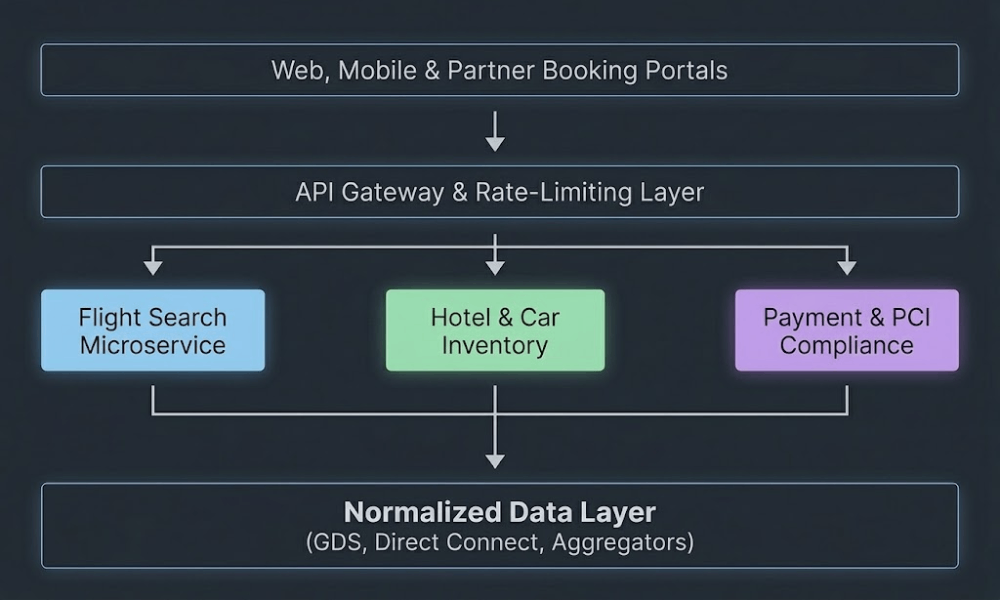
An enterprise booking portal built to scale is not just a larger version of a consumer booking site; it requires a modular engineering approach from day one.
-
Decoupled Microservices: Separate search, booking, payments, and inventory so high-frequency tasks (like flight searches) can scale independently without affecting checkout stability.
-
Direct GDS API Integration: Connect directly to Amadeus, Sabre, or Travelport instead of routing through slow, costly middle-layer aggregators.
-
Caching & Queuing Mechanics: Implement Redis/Memcached and message queues (RabbitMQ/Kafka) to absorb traffic surges during promotions.
-
Data Normalization Engine: Normalize disparate supplier rates, currencies, and availability formats into a unified internal schema in real time.
Integration Is Where Most Projects Fail
Ask any engineering lead who has shipped enterprise custom travel software, and they will tell you the hardest part is not the user interface. It is the airline API integration, the GDS connections, and the constant stream of schema changes from suppliers who rarely warn you before updating their production endpoints.
Challenges of Airline & GDS APIs
| Challenge | Impact on Unprepared Systems | Enterprise Engineering Solution |
| Inconsistent Latency | Slow response times from legacy GDS host systems cause session timeouts | Asynchronous search requests with progressive result streaming |
| Undocumented Schema Changes | Sudden supplier API updates break booking pipelines | Automated contract testing and schema validation pipelines |
| Strict Rate Limits | Sudden traffic spikes trigger vendor IP blocking | Intelligent query caching and fallback supplier routing |
This is where the argument for specialized travel app development services becomes clear. It is not about writing basic code; it is about knowing where GDS systems fail and engineering resilient retry logic, fallback routing, and real-time observability around those exact points. (Learn more about our Software Engineering & API Integration Services).
Architectural Topology for Enterprise Systems
Modern custom travel software relies on containerized services (typically Kubernetes-managed) with clear boundaries between business logic, supplier data, and client applications.
-
Supplier Data Normalization: Rates and availability from multiple GDS providers and direct connects must be normalized before hitting the booking engine. Without this layer, every new supplier integration creates technical debt and custom exceptions.
-
Isolated Payment & PCI Compliance: Payment processing, multi-currency conversion, and audit logging must sit in an isolated security layer to maintain PCI-DSS compliance and simplify multi-market expansion.
-
Real-time Observability: Because GDS and airline endpoints alter behavior without notice, real-time alerting on API latency, error rates, and failed booking transactions per supplier is mandatory.
Moving from Technical Debt to a Clear Engineering Roadmap
Most enterprise travel teams know their current software is holding them back. What they lack is a clear, objective assessment of where technical debt resides and what a migration strategy requires. Guessing leads to either overspending on an unnecessary full rebuild or underspending on temporary patches that fail under load.
Bugloos offers a straightforward Code & Architecture Audit for enterprise platforms. We analyze your booking pipelines, GDS integrations, and scaling bottlenecks to give you a clear, data-backed picture of how to optimize your technology stack.
(Ready to evaluate your booking architecture?
with our technical team.)
Frequently Asked Questions
What are the core benefits of custom travel software over SaaS platforms?
Custom travel software gives you complete ownership over your data model, API integrations, and release cadence without vendor roadmaps or per-booking licensing fees. It removes artificial request caps, lowers long-term TCO, and allows you to build proprietary booking features that differentiate your brand.
How long does it take to build custom travel software?
A scalable enterprise portal with GDS and airline integrations typically takes between 6 and 12 months, depending on integration complexity and supplier migration requirements. Focused MVP builds with limited integrations can launch in 3 to 5 months.
Which GDS APIs do you integrate?
We integrate directly with major Global Distribution Systems including Amadeus, Sabre, and Travelport alongside airline Direct Connect (NDC) APIs. We also build multi-GDS fallback logic to ensure high availability during single-provider outages.
What makes airline API integration harder than standard third-party APIs?
Airline APIs feature strict rate limits, complex legacy XML/JSON schemas, and frequent unannounced updates. Building a reliable integration layer requires dedicated error-handling, asynchronous polling, and automated testing frameworks built specifically for travel data standards.