Custom fintech software development services provide regulated financial institutions, digital banks, and payment providers with complete ownership of their security architecture, compliance workflows, and transactional scalability. Unlike rigid off-the-shelf platforms, custom builds deliver PSD2/PSD3-compliant APIs, bank-grade encryption, and double-entry ledgers that maintain zero-drift accuracy under heavy transaction loads.
With the Digital Operational Resilience Act (DORA) fully enforced across the EU, regulatory bodies like De Nederlandsche Bank (DNB) and the AFM mandate tangible proof of operational resilience such as automated audit trails, verified failover drills, and stringent recovery times directly embedded into the codebase.
For institutions looking to audit infrastructure limits or modernize legacy banking workflows, our analysis of software development for financial services outlines how engineering resilience aligns with European regulatory standards.
Why Off-the-Shelf Platforms Fail at Scale
Packaged banking and payment solutions frequently collapse under growing transactional volume due to core architectural limitations:
-
Database Lock Contention: Standard relational databases updating mutable account balances in place experience severe queueing and deadlocks at scale. A custom append-only, double-entry ledger eliminates lock contention by deriving balances through event logs.
-
Synchronous Cascading Latency: Chaining microservices synchronously in a payment pipeline introduces massive latency delays. Utilizing event streams via Apache Kafka or RabbitMQ processes settlements instantly while offloading fraud detection and notifications asynchronously.
-
Duplicate Processing and Race Conditions: Network drops and user retries risk duplicate charges without strict API idempotency keys, exactly-once ledger mutations, and automated daily reconciliation pipelines.
To diagnose architectural bottlenecks before they cause downtime, review our breakdown of common software development financial problems.

Build vs. Buy: Strategic Evaluation for Fintech Leaders
| Dimension |
Off-the-Shelf Platform |
Custom Fintech Development |
| Data Ownership & IP |
Vendor-locked; schema modifications restricted |
100% proprietary ownership of code and data models |
| DORA & Compliance Audit |
Relies on vendor assertions; hard to audit on demand |
Direct traceability, automated CI/CD evidence generation |
| Scaling & Custom Logic |
Rigid pricing tiers; custom logic requires fragile workarounds |
Tailored ledger logic, zero per-transaction software royalties |
| Best-Fit Use Case |
Generic commodity payments (e.g., standard checkout) |
Proprietary lending engines, multi-currency ledgers, embedded finance |
The most cost-effective path for European scale-ups is typically a hybrid strategy: outsource commodity layers (e.g., card acquisition through Adyen or Mollie) and build proprietary assets such as your core ledger, risk-scoring engines, and partner APIs in-house.
Security & Compliance: Engineering from Day One
Bolting security onto financial software after development guarantees expensive refactoring. Engineering teams must enforce baseline security criteria across all sprints:
-
Continuous Threat Modeling: Map data flows and potential exfiltration points prior to coding.
-
Layered Cryptography: Enforce AES-256 for data at rest, TLS 1.3 for data in transit, and column-level encryption for sensitive IBANs and personal identifiers.
-
Role-Based Access Control (RBAC): Restrict system access via contextual controls paired with immutable, write-once audit logs.
-
CI/CD Quality Gates: Automate dependency vulnerability checks, secret scanning, and compliance policy tests on every pull request.
Standard Architectural Topology for Resilient Fintech Platforms
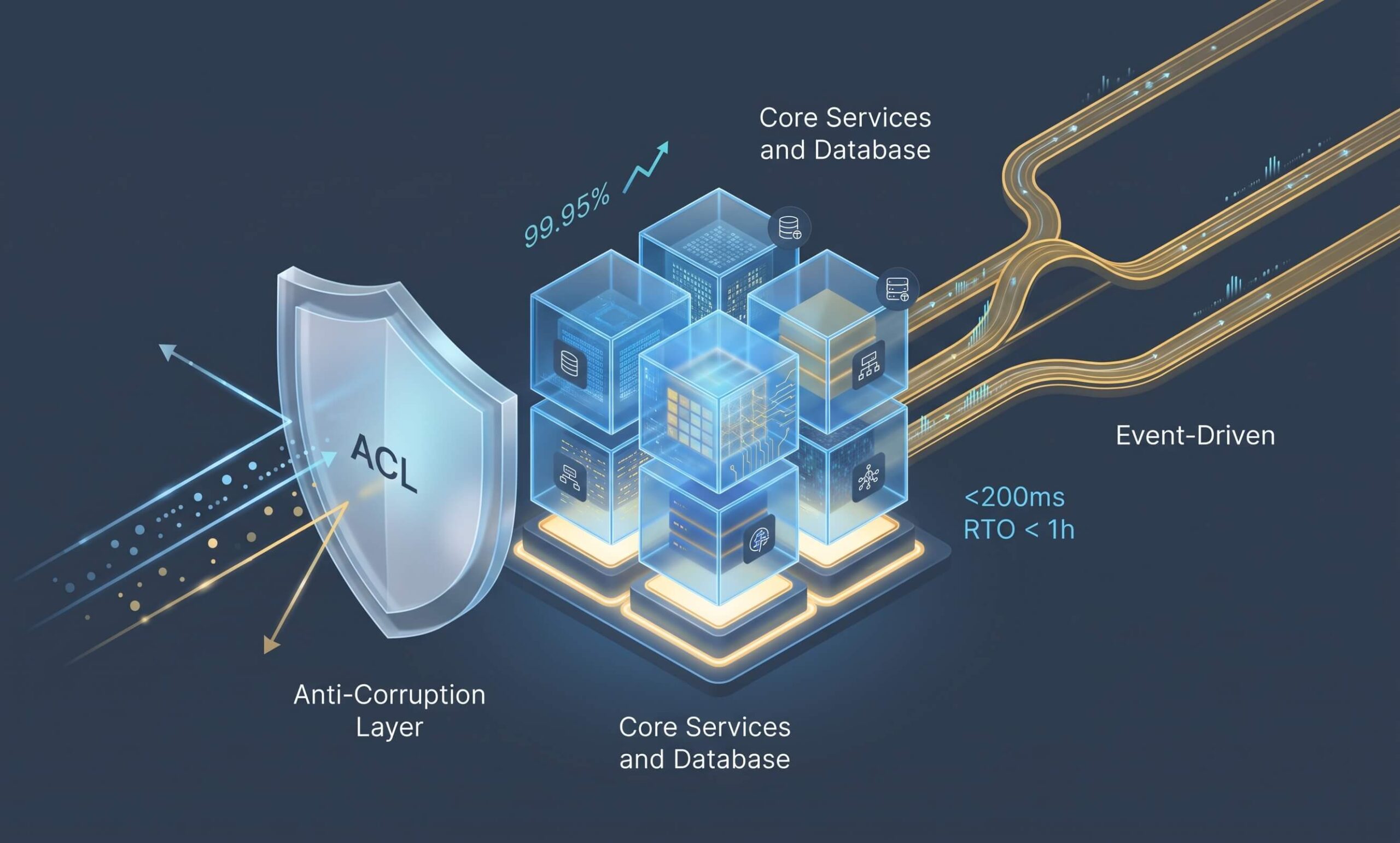
Modern fintech systems favor a modular, typed stack designed for resilience, predictability, and straightforward auditability:
-
Core Services: Strongly typed backends (Java, Kotlin, or TypeScript/Node.js) running on Kubernetes, paired with PostgreSQL as the immutable system of record.
-
Event-Driven Backbone: Apache Kafka or RabbitMQ handles asynchronous settlement tasks, anti-money laundering (AML) screening, and event notifications.
-
Anti-Corruption Layer (ACL): Legacy core-banking connections and third-party payment rails sit behind an ACL to prevent external schema changes from corrupting the internal ledger.
-
Operational Benchmarks: Systems should maintain 99.95% uptime, API latency under 200ms (P95), a Recovery Time Objective (RTO) under 1 hour, and a near-zero Recovery Point Objective (RPO) for transactional records.
Transitioning from Technical Debt to a Scalable Roadmap
Unmonitored technical debt, unindexed transactional tables, and unvalidated third-party dependencies expose fintechs to severe operational and regulatory penalties.
Bugloos provides a comprehensive Code & Architecture Audit for European financial platforms. We evaluate your ledger design, API idempotency, failover protocols, and DORA readiness to deliver an objective, prioritized engineering roadmap.
(Ready to secure your fintech infrastructure and ensure regulatory compliance? Contact our team for an objective Code & Architecture Audit.)
Frequently Asked Questions
How much do custom fintech software development services cost?
A focused MVP covering essential payment or lending workflows typically ranges between €80,000 and €250,000. A comprehensive enterprise platform with custom ledgers, automated reconciliation, and regulatory compliance tooling averages €300,000 to €800,000.
How long does it take to build a custom fintech platform?
A production-ready MVP usually takes 4 to 6 months. Expanding to an enterprise-grade platform compliant with DORA and PSD2/PSD3 standards generally requires 9 to 14 months, factoring in penetration testing and third-party bank integrations.
Which regulatory standards govern fintech software development in the Netherlands and the EU?
Fintech applications operating in Europe must comply with DORA (operational resilience), PSD2/PSD3 (payment service APIs), GDPR (data privacy), and PCI DSS (if handling cardholder data), supervised locally by the DNB and AFM.